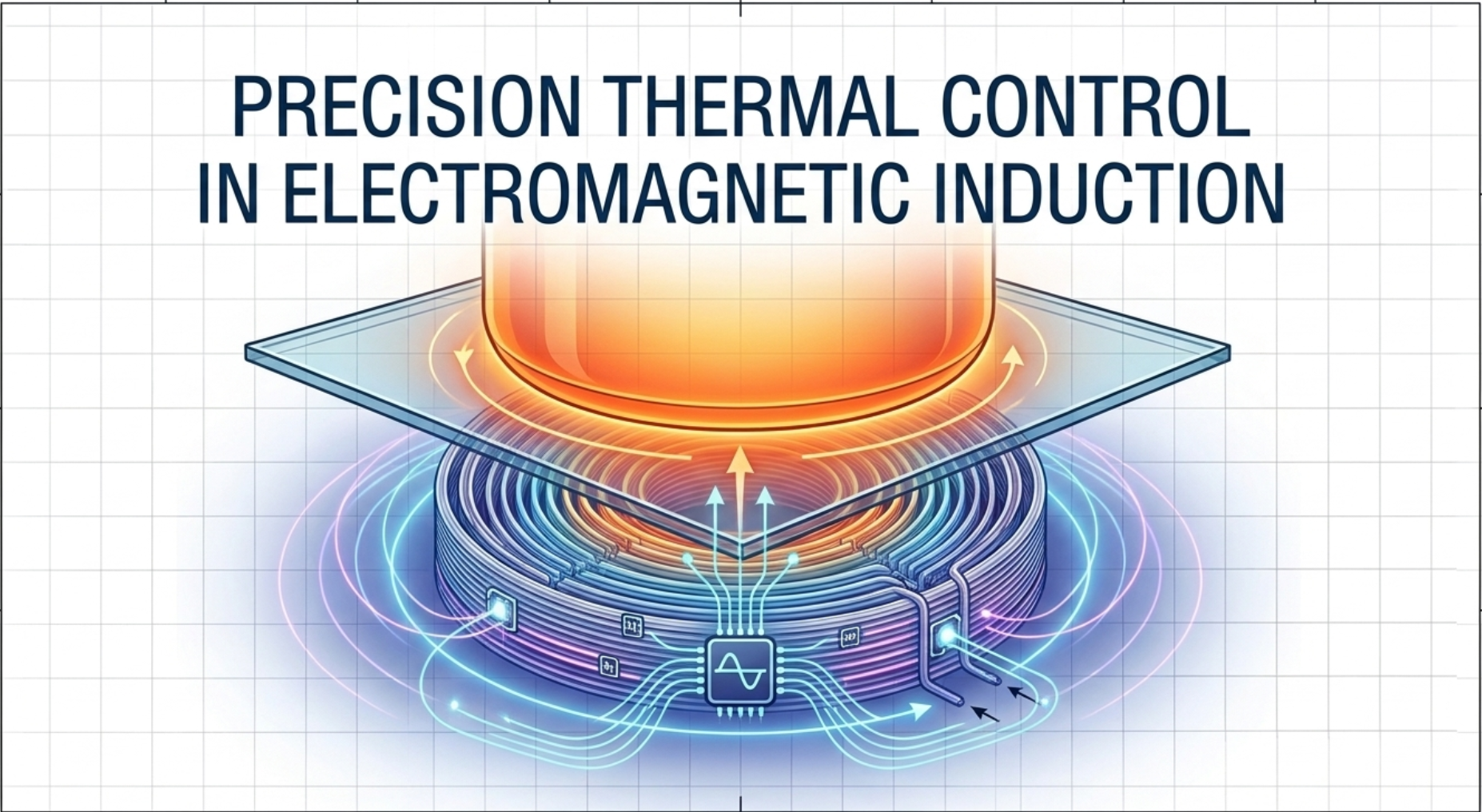
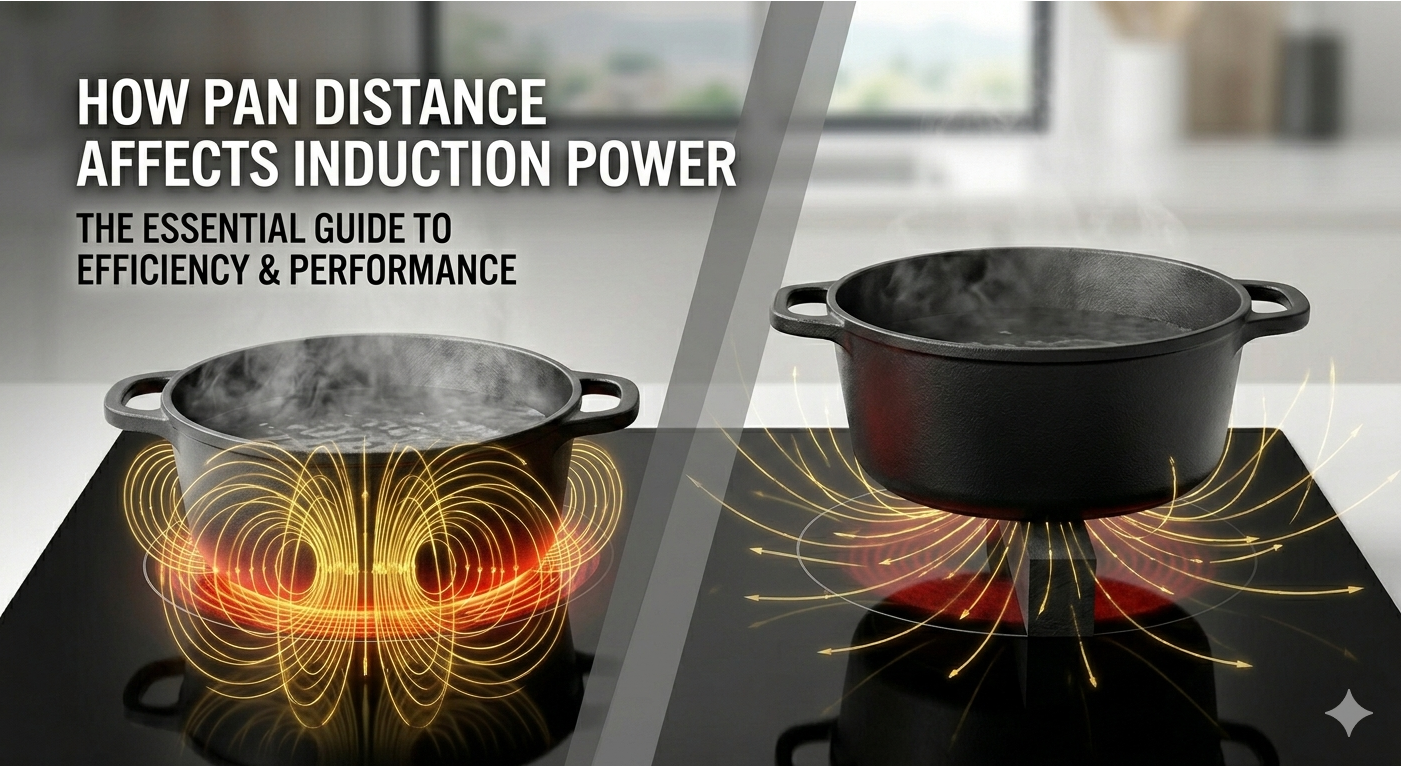
The evolution of modern induction technology has fundamentally revolutionized both high-end industrial thermal processing and everyday consumer appliances. At the heart of this revolution is induction heating—a process that uses alternating electromagnetic fields to generate localized heat directly within the base of a ferromagnetic pan or workpiece, bypassing the need for an external flame or radiant heating element.
However, as advanced culinary techniques like vacuum low-temperature cooking (sous-vide) and ultra-precise industrial manufacturing become more mainstream, traditional induction setups hit a physical wall. Achieving a rock-steady temperature without massive overshoots requires a deep understanding of how modern engineering overcomes thermal lag through advanced sensors, smart power delivery, and intelligent control software.
1. The Hidden Bottleneck: Why Traditional Induction Systems Lag
To understand why a standard induction cooktop often struggles with precise temperature control, we have to look underneath the hood. In a classic induction setup, the temperature sensor—known as a Negative Temperature Coefficient (NTC) thermistor—is glued directly beneath the glass-ceramic surface.
While glass-ceramic is incredibly durable, handles high heat beautifully, and acts as an excellent electrical insulator, it has one major flaw: it is a terrible conductor of heat.
[Traditional System Lag]Cookware Base (Hot) ---> Glass-Ceramic Panel (Insulator/Slow) ---> Sensor (Delayed Reading)
This structural layout creates a significant physical delay. The heat from the pan must slowly seep through the glass panel before the sensor even registers a change. Because different batches of glass can vary slightly in thickness, the control system is essentially guessing how long it takes for the heat to travel. This seconds-long delay causes a classic feedback loop error. By the time the sensor realizes the pan is too hot and tells the system to reduce power, the pan has already overheated, causing the temperature to swing wildly up and down.
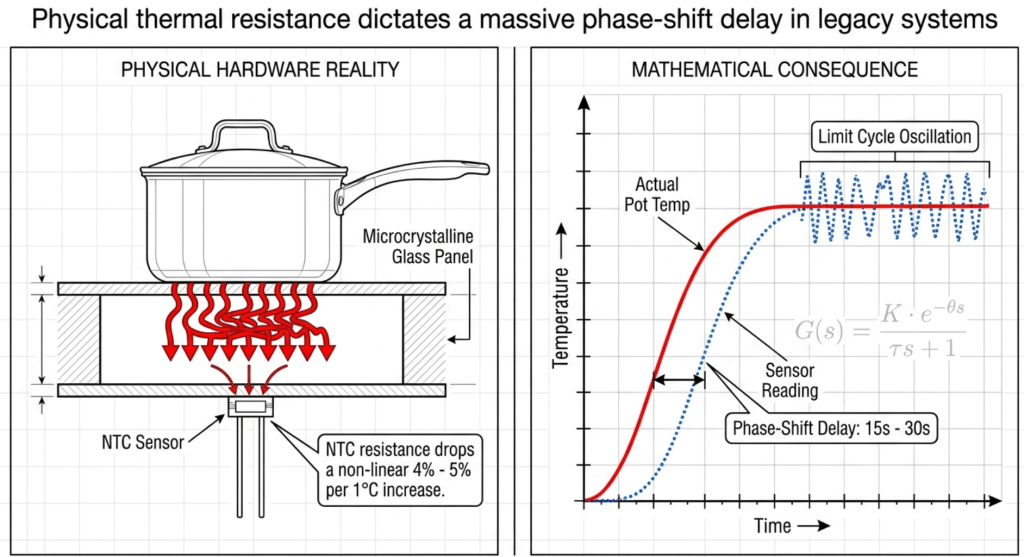
To eliminate this barrier, next-generation premium induction systems replace standard glass-ceramic with high-performance alumina ceramic panels blended with 95% to 99% pure alumina. Alumina ceramic transfers heat significantly faster than traditional glass. This simple material upgrade dramatically cuts down on physical delay, allowing the sensors beneath the surface to instantly catch split-second temperature drops or spikes at the bottom of the pan.
2. Next-Gen Sensor Topologies: Seeing Through the Glass
To completely break free from the limitations of measuring through a glass panel, the induction industry has developed a multi-dimensional matrix of smart tracking options.
Smart Contact Sensors and Wireless Cookware
One straightforward engineering solution is to change where the sensor sits. Some high-precision induction systems use a spring-loaded tactile probe that physically punches through the middle of the induction coil, pressing directly against the center of the cookware base. To protect the internal electronics from accidental boil-overs, these assemblies feature clever drainage channels that safely guide spilled liquids away from the hardware.
An even more advanced approach moves the sensors inside the cookware itself, entirely bypassing the glass panel delay. Smart pans utilize low-power Bluetooth (BLE) modules embedded in the handle or lid, connected to a probe that sits directly inside the food or liquid. This creates a seamless two-way communication channel: the pan monitors the exact temperature of the food and beams it wirelessly to the induction cooktop’s main computer, which instantly dials the power up or down.
Infrared (IR) Sensing with Optical Filters
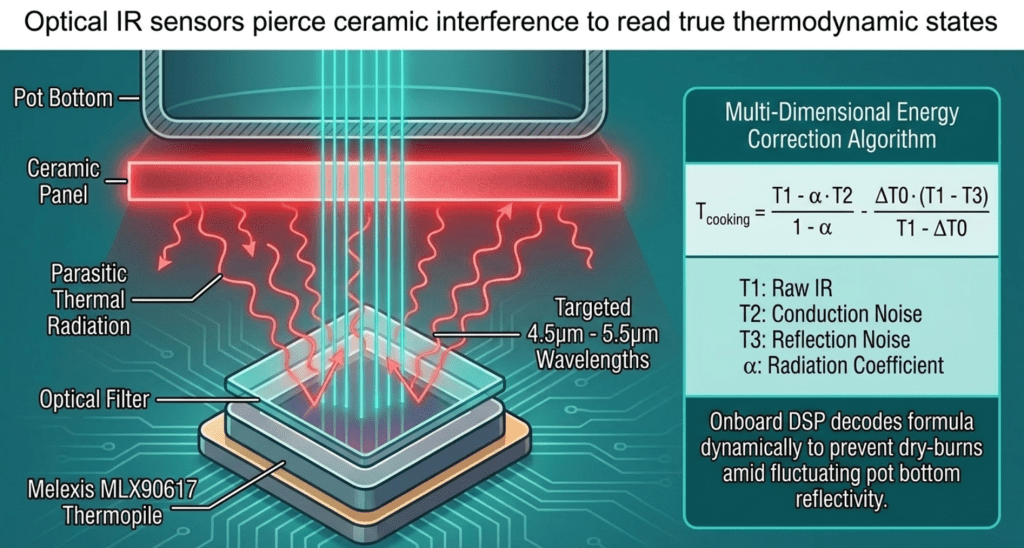
Non-contact infrared sensors can read temperature changes in milliseconds, completely erasing thermal lag. However, a raw infrared sensor placed beneath a cooktop gets blinded by the heat radiating from the glass panel itself.
To bypass this issue, advanced systems employ specialized optical filtering technologies (such as the Melexis MLX90617 platform). These sensors use a customized optical lens that blocks out the specific infrared wavelengths emitted by the hot glass panel, while allowing the distinct infrared rays shooting off the bottom of the pan to pass through completely unimpeded.
[Infrared Optical Filtering]Pan Bottom (Emits IR) ---> Glass Panel ---> [Optical Filter blocks Glass Heat] ---> IR Sensor Reads Pan
Because pans can warp, scratch, or oxidize over years of use—which changes how they reflect light—the system runs a real-time compensation program. It automatically subtracts background heat noise from the coil or surrounding environment, giving the system a flawless, lag-free read on whether a pan is approaching a dangerous boil-dry or empty-pan state.
Sensorless Electromagnetic Impedance Tracking
The absolute peak of induction innovation is tracking temperature without using a physical temperature sensor at all. This method treats the induction cooktop and the pan as a high-frequency transformer: the main induction heating coil acts as the primary power source, while the metal pan acts as the transformer’s core.
Because the electrical resistance and magnetic properties of metals change predictably as they get hotter, the system can calculate temperature purely by monitoring the electrical signals flowing through the circuit. By comparing the driving current sent into the main coil against the voltage induced in a secondary measurement coil, the system calculates the real-time electrical impedance. The onboard computer looks up this electrical thumbprint in a pre-calibrated database to instantly deduce the pan’s temperature without a single thermometer.
3. Smooth Power Delivery: Eliminating the “Click and Pulse” Malady
An accurate temperature reading is only useful if the induction cooktop can smoothly fine-tune its heat output. Traditional entry-level induction cooktops struggle when asked to run at low power settings (like 200W to 500W). To achieve low heat, they are forced to cycle completely on and off every few seconds, resulting in a frustrating pattern where your food violently boils for a moment, stops completely, and boils again.

Pulse Skipping Technology
To achieve a perfectly steady simmer, modern systems use Pulse Skipping Technology. Instead of turning the system completely on and off for seconds at a time, the onboard computer operates on a millisecond timescale.
The system looks at the alternating current (AC) power waves coming out of your wall outlet. For low-power cooking, it lets the power flow normally through a few waves, and then cleanly skips or “mutes” the next few waves. Because these adjustments happen hundreds of times a minute, the physical mass of the pan acts as a natural thermal blanket, smoothing out the tiny electrical pulses into a completely steady, continuous stream of low heat. This makes it easy to melt chocolate or simmer delicate sauces without burning them.
Half-Bridge Inverters with Variable Phase Control
For premium multi-zone consumer cooktops and heavy-duty industrial induction systems, engineers use a layout called a half-bridge resonant inverter. This design uses two primary electronic switches (IGBTs) working in perfect harmony to handle wide power ranges seamlessly.
To keep the system running efficiently and cleanly across all power levels, it automatically shifts between two distinct modes:
- High-to-Medium Power: The system keeps its switching gates open at an even ratio and slightly tweaks the electrical frequency to increase or decrease total heat energy.
- Ultra-Low Power: When the frequency cannot safely go any higher, the system shifts the timing (the phase angle) between the two switches. By intentionally throwing the switches slightly out of sync, the electrical waves inside the machine partially cancel each other out. This allows the cooktop to output an incredibly weak but perfectly continuous stream of heat without turning off.
4. Intelligent Software: The Brains Behind the Power
Even the best sensors and power components require smart software to pull everything together. Because cooking environments are highly unpredictable—heating an empty cast-iron skillet behaves very differently from heating a large pot of cold soup—static, old-school software quickly fails.
Digital Filtering and Adaptive Logic
Because the inside of an induction cooker is filled with massive high-frequency electromagnetic fields, raw sensor signals are plagued with electrical background noise. Modern processors route these raw signals through a digital Kalman Filter. This advanced math filter acts as an intelligent noise-canceling system, cleanly stripping away voltage spikes and electromagnetic distortion to deliver a pure, accurate line graph of the pan’s actual heat progression.
Next, rather than relying on fixed rules, the cooktop uses an adaptive Fuzzy Logic PID control loop. When you first turn the machine on, it monitors how much energy is being pumped into the pan versus how fast the temperature rises. This allows the software to calculate the exact size, weight, and thermal footprint of your cookware on the fly.
[Adaptive Fuzzy Logic Loop]Identify Pan Weight/Type ---> Run High Power (Fast Rise) ---> Soft Landing at Target (No Overshoot)
If it detects a heavy, cold pot of water, it aggressively ramps up the power to speed up boiling times. As the temperature approaches your target setpoint, the software automatically shifts gears, scaling back the power and increasing dampening controls to glide perfectly into the target temperature without overshooting. Long-term performance tracking reveals that by eliminating the wasteful overcorrection cycles common to rigid systems, these smart adaptive algorithms cut overall energy consumption by up to 18.7%.
Summary of Modern Thermal Management Topologies
To see how these engineering choices stack up, we can look at the physical tradeoffs across different approaches:

Conclusion
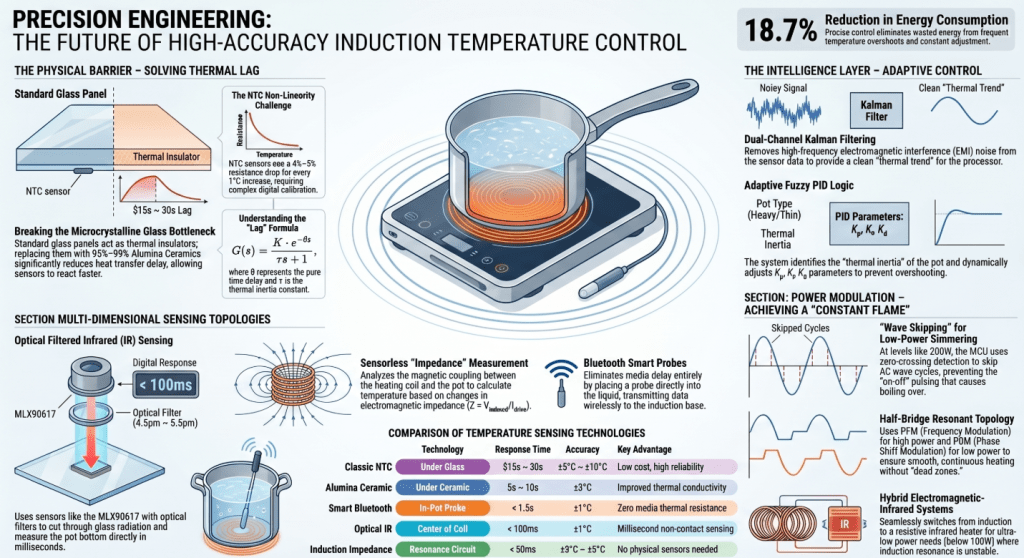
True precision in induction heating applications cannot be achieved with single, isolated upgrades. It requires a unified system engineering approach. By replacing sluggish thermal pathways with fast-acting materials like alumina ceramics or non-contact infrared sensors, pairing them with continuous inverter architectures like half-bridge phase-shifters, and wrapping the hardware in intelligent adaptive software, modern induction systems can achieve industrial-grade thermal stability. This ensures faster heating times, incredible energy efficiency, and perfectly stable temperatures regardless of what is cooking in the pan.