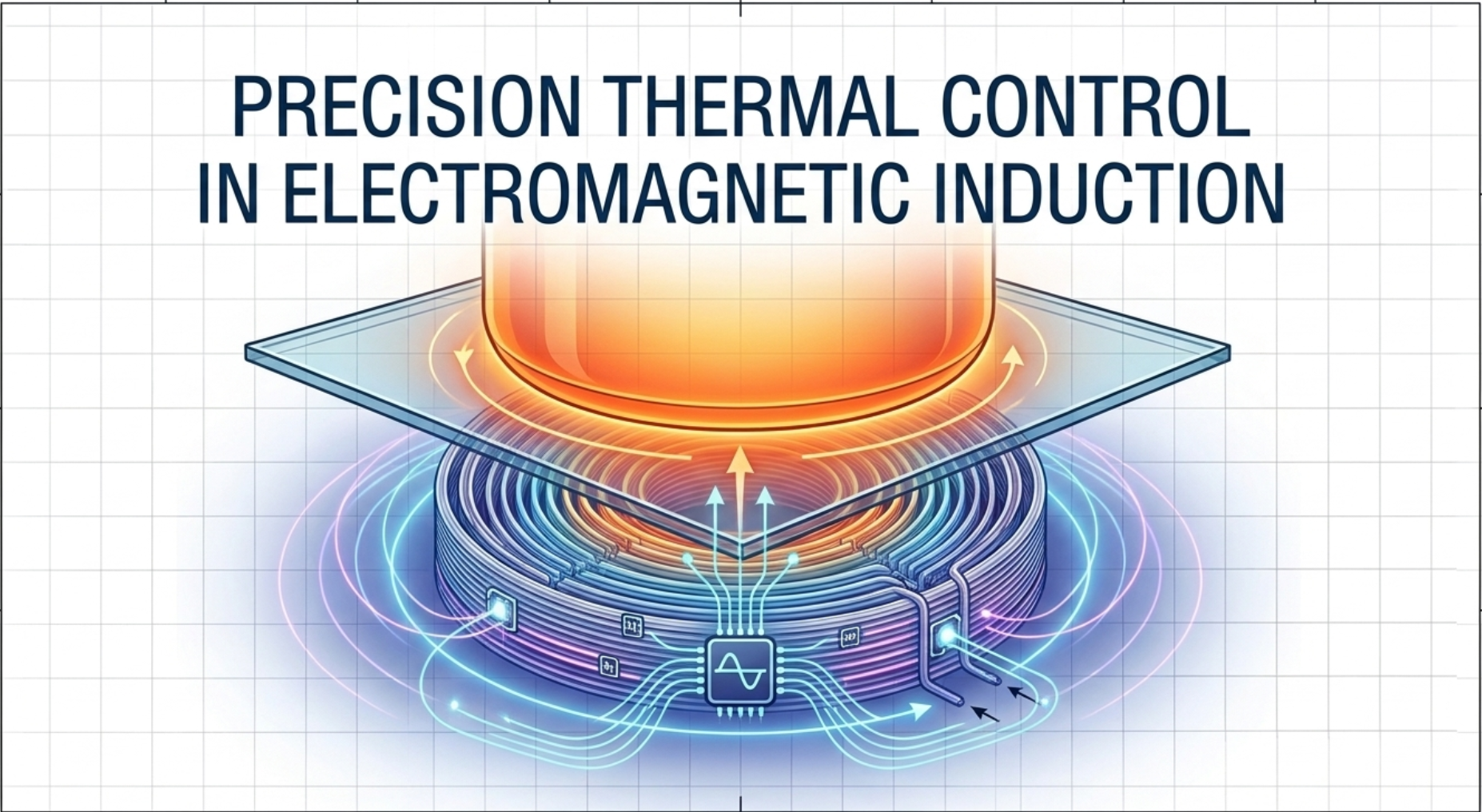
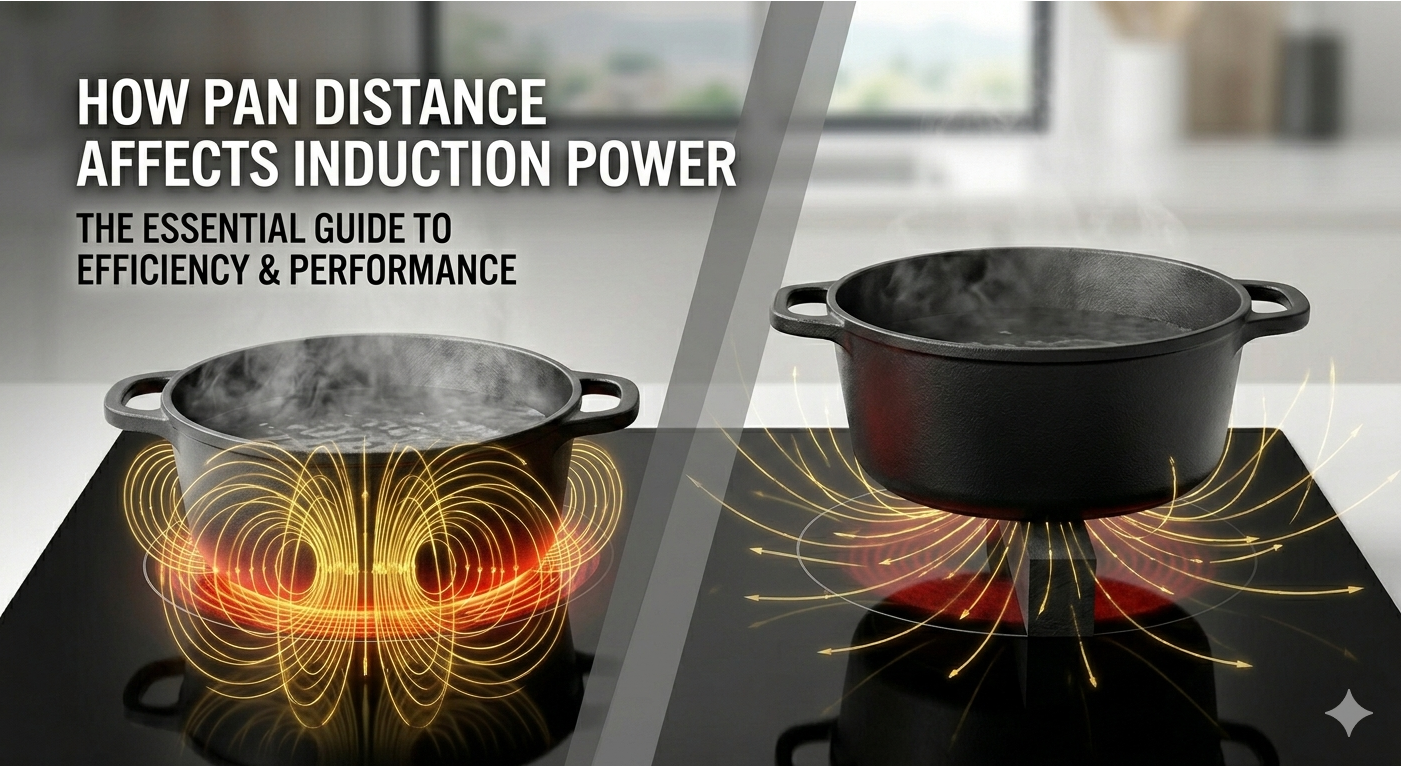
In the evolution of high-end induction technology, the most significant breakthrough is not just the power of the heat, but the intelligence of the sensor. Automatic Pot Detection has transformed the induction cooktop from a simple heating element into a responsive, smart surface. While features like Full Surface and FlexInduction provide the physical space, it is the detection algorithm that enables the “equipment to adapt to the person” rather than forcing the person to adapt to the equipment.
1. The Physics of Sensing: How the Coil “Sees” the Pot
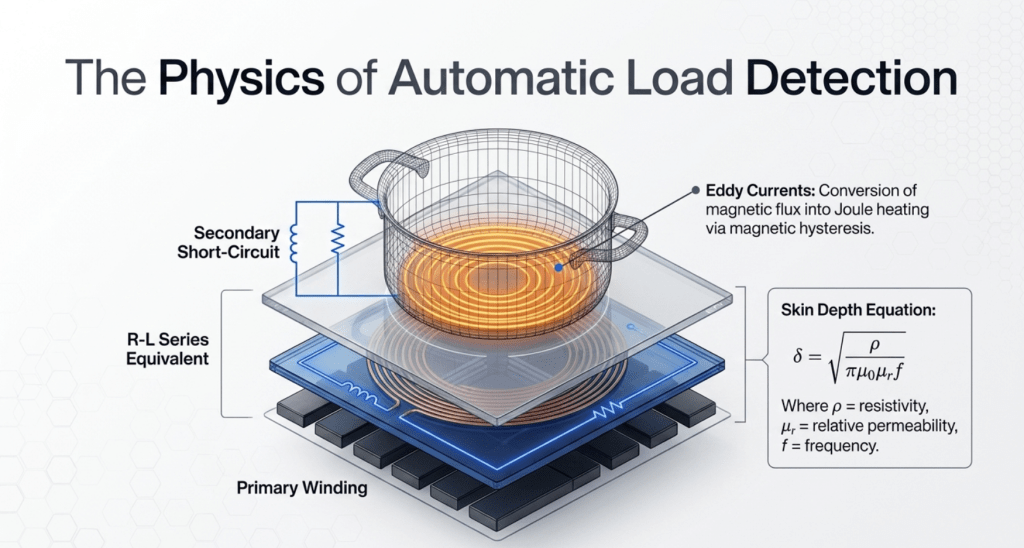
The fundamental core of automatic detection is using the induction coil itself as a high-sensitivity sensor. By monitoring how a load affects the electrical parameters of the resonant circuit, the system can “see” what is happening on the glass surface.
Electromagnetic Feedback and Impedance
The system operates on Faraday’s Law of Induction. When high-frequency alternating current flows through the coil, it creates a magnetic field.
- Eddy Current Analysis: When a ferromagnetic pot enters this field, internal eddy currents are generated.
- Equivalent Circuit Modeling: The system treats the coil as a primary winding and the pot as a shorted secondary winding. The total impedance ($R$ – $L$ model) shifts based on the pot’s material, thickness, and the distance from the coil.
- Pulse Probing: In standby mode, the system emits low-power “probes” every few milliseconds. If the resonant frequency shifts toward the high-frequency spectrum, the system confirms a pot is present.
2. Advanced Detection: Ferrite Bars and Signal Reconstruction
To achieve high-end precision, premium cooktops utilize Ferrite Bars beneath the coils to act as magnetic field concentrators.
- Magnetic Flux Capturing: Secondary monitoring units on these ferrites capture changes in magnetic flux .
- Spatial Resolution: If a pot is off-center or only partially covers a coil, the system detects an asymmetrical induced electromotive force.
- Geometric Reconstruction: The Microprocessor (MCU) uses A/D converters to process these analog signals, reconstructing the physical outline and center of gravity of the pot with millimeter-level accuracy.

3. Power Management: Adapting to the Detection Data
Once a pot is detected, the system must decide how to distribute power. This is where the detection intelligence meets the heating hardware.
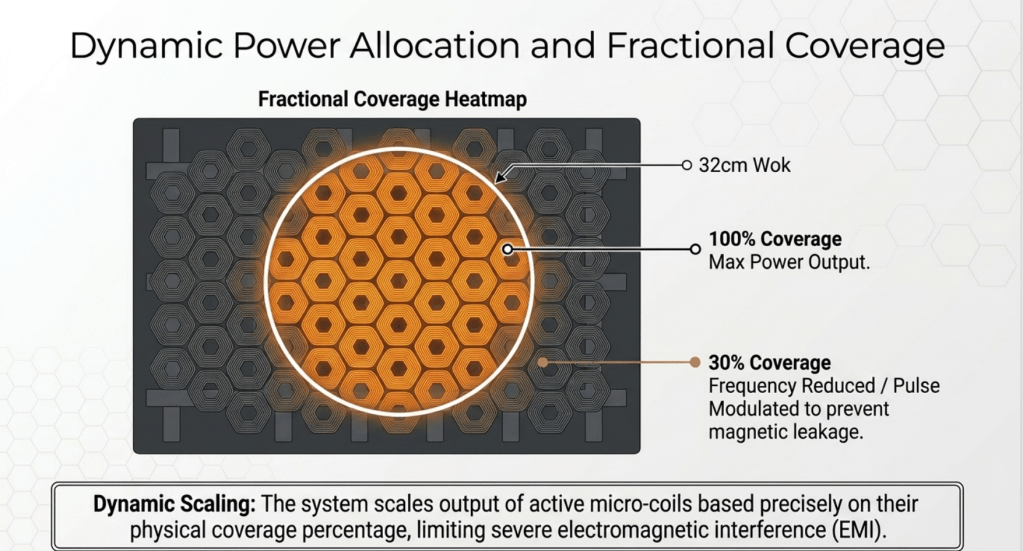
- Dynamic Power Allocation: If a pot only covers 30% of a specific coil, the system reduces that coil’s pulse density or frequency to avoid “leakage flux,” which would otherwise cause electromagnetic interference or energy waste.
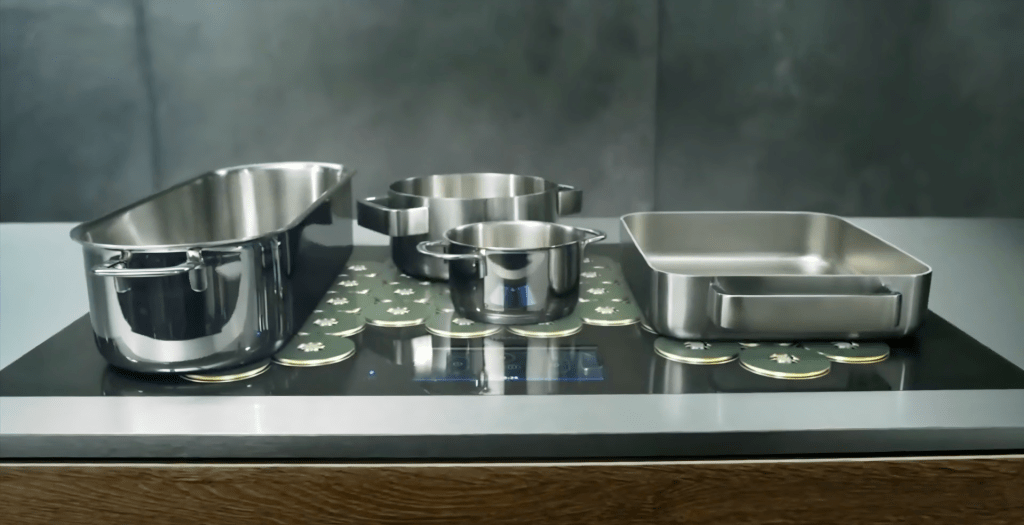
- Matrix Coordination: In Full Surface models (featuring 48 to 56 micro-coils), the detection algorithm identifies all covered coils and merges them into a single “logical heating entity”.
- ZVS (Zero Voltage Switching): To handle the frequent switching required by smart detection, high-end units use ZVS to ensure components switch at zero voltage, extending the lifespan of the electronics.
4. Feature Extensions: Setting Transfer and AI Recognition
The “brain” of the pot detection system allows for advanced features that define the premium experience:
- Setting Transfer: When a user moves a pot, the system captures the signal decay in the original area and the simultaneous signal increase in the adjacent zone. It then automatically migrates the power level, timer, and settings to the new location.
- Material Identification: By analyzing the harmonic components of the current through Fast Fourier Transform (FFT), the system can distinguish between cast iron and composite stainless steel, optimizing the temperature control algorithm accordingly.
- Invisible Induction (2025-2026 Trend): Modern detection is now sensitive enough to penetrate 12mm to 20mm of stone or porcelain, allowing for “invisible” cooktops installed directly beneath the countertop.
5. Technology Roadmap: Comparison of Detection Logic
| Technology | Detection Capability | Implementation Strategy |
| Full Surface Matrix | Highest; recognizes irregular shapes and 360° movement. | 50+ micro-coils with complex matrix inverters. |
| FlexInduction | Medium; recognizes rectangular or large circular pots. | 4-8 oval/octagonal coils in specific vertical/horizontal zones. |
| Standard Zones | Low; only detects if a pot is present or absent. | Single large coil; requires center alignment. |

Conclusion
The future of induction heating is not measured by raw wattage, but by the sophistication of its Automatic Pot Detection. By mastering the $RLC$ resonant characteristics and real-time signal reconstruction, manufacturers can offer a truly “borderless” cooking experience. As AI and wide-bandgap semiconductors like GaN become standard, this detection will evolve from simple “pot sensing” to full “culinary awareness”.